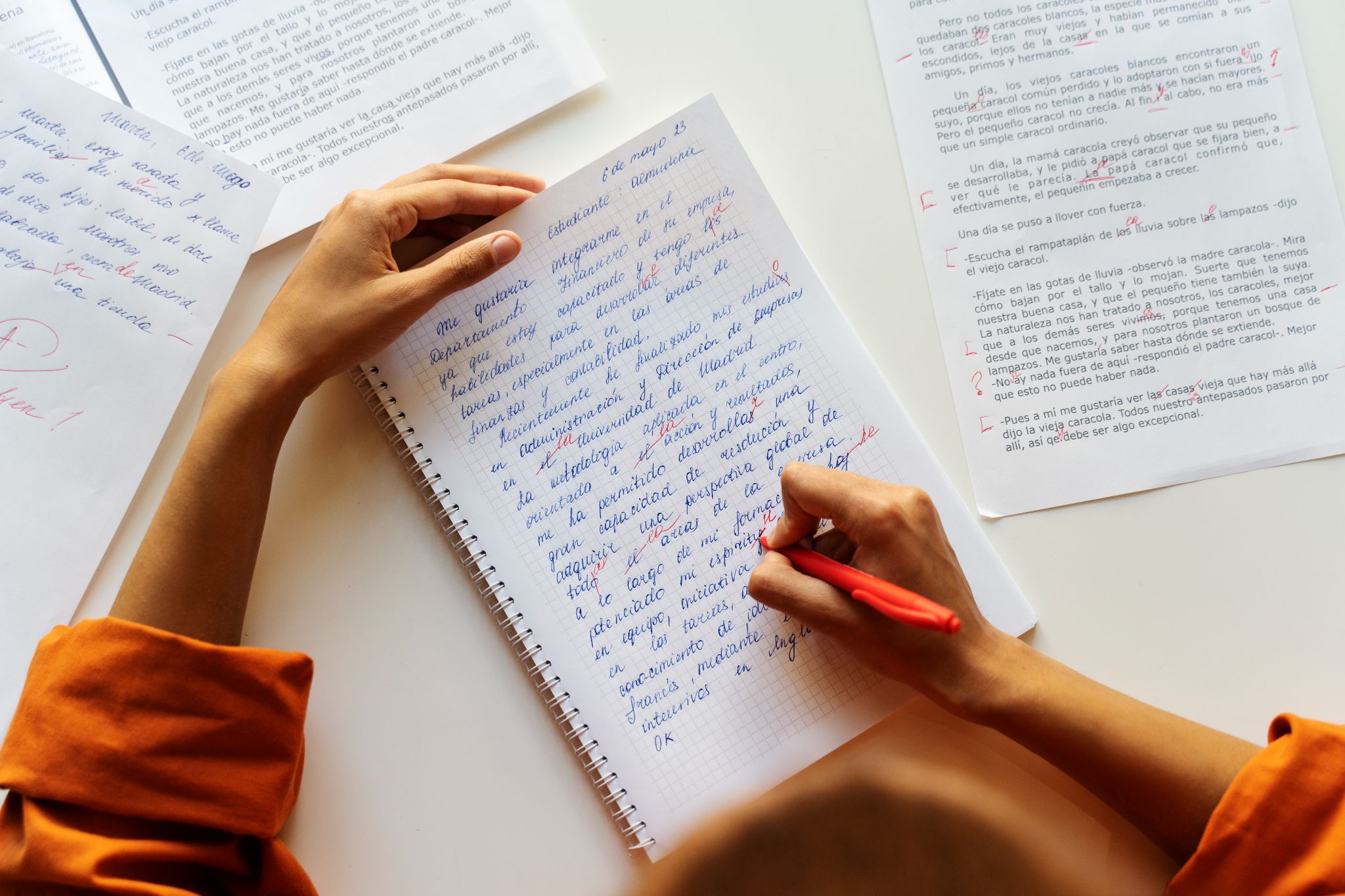
Commonly Misspelt Words Every PSLE Student Should Know

The PSLE English Language paper tests students across four components: Writing, Language Use and Comprehension, Listening Comprehension, and Oral Communication. Within the written papers alone, a student’s spelling is put to the test in Editing, Comprehension Cloze, Synthesis and Transformation, and Composition Writing. This means that while there is no separate spelling section, accuracy is assessed across much of the examination.
Consider a straightforward scenario: A student writes the correct answer in a Comprehension Cloze passage. The word fits the context, the grammar is sound, and the meaning is accurate. But the spelling is wrong, and the mark is not awarded. For parents reviewing their child’s marked papers, few things are more frustrating than watching marks slip away on words their child clearly knows.
Frustration compounds when one realises how far spelling errors reach across the paper. In Editing, the task demands precision down to the letter. In Comprehension Cloze, an answer spelt incorrectly is scored the same as a wrong answer. In Synthesis and Transformation, a single misspelt word can undermine an otherwise well-constructed sentence. And in Composition Writing, repeated errors drag down the Language mark, even when the ideas and structure are strong. The student is penalised, even if they knew the right answer.
What makes this especially difficult for parents and students alike is that these are rarely unfamiliar words. Most commonly misspelt words are ones your child uses in conversation, reads in books, and understands without hesitation. The problem is not vocabulary. Recognising a word on a page and reproducing it accurately under timed conditions are two very different skills. When the clock is ticking and the pressure is on, students tend to write what sounds right. However, for many of these words, the way they sound and the way they are spelt do not match.
The good news is that the same words tend to cause trouble year after year. They are predictable, they follow patterns, and with the right kind of practice, they can be addressed well before exam day.
Below is a list of 50 commonly misspelt words that Primary 5 and Primary 6 students should learn to spell correctly, selected because they appear frequently across school-level writing and exams.
|
absence |
accommodate |
accumulate |
achieve |
acquaintance |
|
acquire |
aggressive |
amateur |
apparent |
argument |
|
ascend |
athlete |
athletics |
beginning |
believe |
|
calendar |
conscience |
conscious |
convenient |
desperate |
|
diarrhoea |
dilemma |
disastrous |
discipline |
dissatisfied |
|
embarrass |
environment |
exaggerate |
exhilarate |
familiar |
|
foreigner |
government |
guarantee |
independent |
inevitable |
|
maintenance |
necessary |
noticeable |
occasion |
occurrence |
|
perseverance |
possession |
privilege |
profession |
receive |
|
rhythm |
separate |
sincerely |
unanimous |
unconscious |
How to Use This Commonly Misspelt Words List
Fifty words on a page can look like a lot, especially with the PSLE on the horizon. One might be tempted, understandably, to try to get through all of them in one sitting.
We would strongly recommend against such an approach.
A student might be able to manage a spelling quiz the next morning, but without regular revisiting, most of these will have faded by the end of the week. After all, spelling is not a topic that responds to cramming. It builds through spaced-out practice and proper usage over time.
A sustainable approach is to work through ten to fifteen words per week. For each word, your child should check the spelling, read the meaning, and then write it in a full sentence.
Writing a word in context ties it to a scenario, a character, or an idea, which gives the brain far more to anchor to than the letter sequence alone. “Desperate,” for instance, is easier to recall correctly when your child has used it in a sentence about a character in a composition, rather than simply copied it five times off a list.
Over the course of several weeks, the full list is easily manageable. The words that need the most attention will also surface naturally, and those are exactly the ones worth spending extra time on.
Practice Techniques That Build Accuracy
A weekly spelling quiz at home takes very little time and reveals a great deal. There is no need to try for perfection on every attempt. The point of the exercise is to identify which words keep coming back wrong, so that practice can be directed where it is needed.
When a word is misspelt, have your child rewrite it several times, slowly. For longer words, breaking them into parts makes the structure visible. Some of the most persistent errors come down to one small detail. For example:
- Accommodate contains both a double ‘c’ and double ‘m. Once your child notices that, it becomes something concrete to check for every time.
- Occurrence follows a similar structure: double ‘c’, double ‘r. Students often drop one of each.
- Separate causes persistent errors because the middle vowel sounds like an ‘e’ when spoken aloud, but is actually an ‘a’.
These are not isolated quirks. Many common spelling mistakes in English share the same underlying features: doubled consonants that get reduced to one, unstressed vowels that could go either way, and silent letters that get left out entirely. When your child starts to recognise these patterns across different words, each new spelling becomes easier to learn.
Memory Techniques for ‘’Stubborn’ Words

Some words resist even consistent practice. Your child spells them correctly three days running, then writes them wrong a few days later. For these, repetition alone is not enough. A different approach is worth trying.
- Visualisation: Have your child close their eyes and picture the word letter by letter, as though reading it off a whiteboard.
- Spelling aloud while writing: Saying each letter as it is written engages the ear alongside the hand and eye, which strengthens recall under exam pressure.
- Chunking longer words: Splitting unfamiliar spellings into smaller, pronounceable parts is easier than treating them as a single block of letters. ‘Diarrhoea’ becomes ‘di-arrh-oea’. ‘Maintenance’ becomes ‘main-ten-ance’.
- Mnemonics: For the worst offenders, a memorable phrase gives the brain something to reach for. “Rhythm Has Your Two Hips Moving” maps to R-H-Y-T-H-M. ‘Necessary’ becomes ‘one collar, two sleeves,’ for one ‘c’ and double ‘s’.
What ties all of these techniques together is regularity. A single session, no matter how focused, will not produce lasting results.
How Parents Can Support Spelling Practice
Regularity is where parents can make the biggest difference. Supporting your child’s spelling does not require workbooks or specialist materials. A few minutes built into the daily or weekly routine, kept consistent, will match an expensive resource. The most useful things parents can do are simple:
- Run short oral quizzes at home: Read a word aloud, ask your child to spell it, and check together. Five minutes a few times a week is more productive than an hour once a fortnight.
- Mix old words back in: Rotating older words in alongside new ones prevents the cycle of learning, forgetting, and relearning.
- Encourage regular reading: Children who read often see correct spellings in context repeatedly, and that exposure builds a familiarity that carries into their own writing.
Preparing for the PSLE English Paper
Beyond this list, encourage your child to start keeping a personal spelling list drawn from their own schoolwork. Every marked assignment, class test, and timed practice paper is a source of information. The words your child has already misspelt are the ones most likely to cause problems again, and writing them down in one place makes revision targeted rather than general.
In the weeks leading up to the PSLE English paper, reviewing that personal list focuses preparation on the specific words that have cost marks before. This kind of targeted revision is more productive than working through generic word lists with no connection to your child’s actual patterns of error.
For students who benefit from structured guidance alongside home practice, Academia’s Primary 6 English tuition classes address spelling, grammar, and composition technique within a curriculum developed and refined in-house each year. Our primary school English tuition classes are kept small so that each student receives detailed, individualised feedback. If your child is preparing for the PSLE and you are looking for P6 English tuition that prioritises precision and depth, reach out to the Academia team to find out more.
Register for a class now!
Related Articles

Good Phrases to Describe Happiness in Primary School Composition